Free printableElectrical and wiringTSP-EL-04
Scooter fuse record and circuit map
What fuse protects what, on a machine whose wiring diagram does not match anybody else's. Plus the blade fuse colours, from the manufacturers' datasheets.
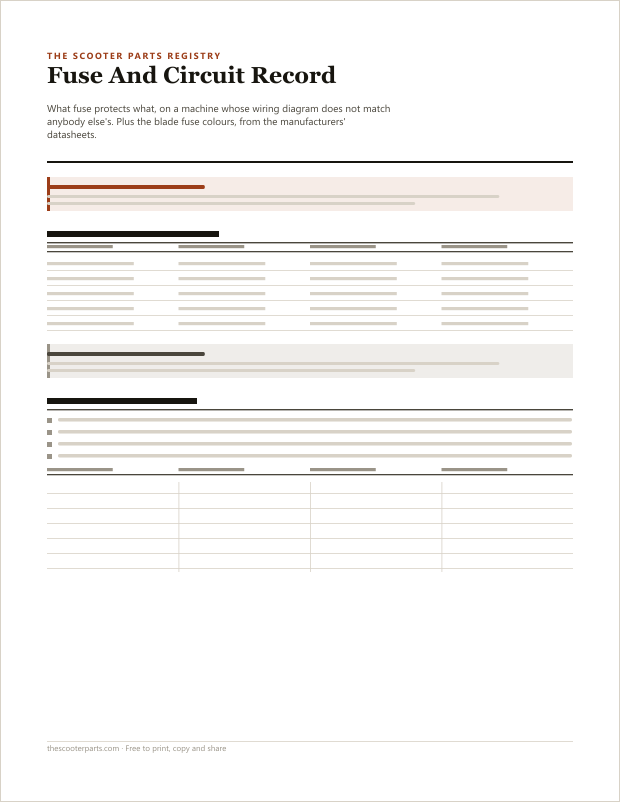
Layout preview of page one. The PDF itself is typeset text, not an image.
Download — free, no email
3 pages. No account, no sign-up, no newsletter. Print it, copy it, hand it to somebody else.
TSP-EL-04 · version v1.0 · September 2026. Opens in your browser's PDF viewer, where you can print directly.
The problem it solves
These machines frequently have one or two fuses protecting everything, no legend anywhere, and a previous owner's replacement of the wrong rating sitting in the holder looking perfectly normal. When something electrical stops working, nobody knows which fuse to look at or what should be in it.
A fuse is the cheapest component in an electrical system and the only one designed to fail. That makes it the best diagnostic starting point there is — and on these machines it is almost useless, because nothing tells you which circuits it protects.
So the useful sheet is not a chart of what the fuses do. It is a map you build yourself, once, by pulling each fuse and noting what stops working. Twenty minutes, and it is correct for your machine rather than for somebody's photograph of a different one.
The blade fuse colour table is included because that part genuinely is standardised — the ratings and colours come from the fuse manufacturers' own datasheets. But the colour is always a cross-check and never the authority: the rating is stamped on top, and a wrong fuse fitted by a previous owner is exactly the fault you are hunting.
The mistakes this sheet exists to prevent
- Fitting a larger fuse to stop one blowing, which moves the failure from the cheapest component to the wiring.
- Bridging a fuse holder with foil or wire, which removes the protection entirely.
- Reading a fuse's rating from its colour rather than from the number stamped on it.
- Mixing standard ATO/ATC and smaller MINI fuses, which share a colour code but are different families.
- Replacing a blown fuse without asking why it blew. It failed on purpose.
Who it is for
- Anyone whose lights, horn or indicators have stopped and who does not know which fuse to check
- Owners of a machine with no wiring diagram that matches it
- Anyone whose fuse keeps blowing
What is on it
- Blade fuse rating-to-colour, verified against manufacturer datasheets
- A pull-one-fuse-at-a-time method for mapping your own circuits
- A circuit map you fill in once and keep with the machine
- What a repeatedly blowing fuse is telling you
How to use it
- 01Map the fuses once, with the key on, by pulling each in turn and noting what stops working.
- 02Write the map on this sheet and leave it with the machine.
- 03Read the rating off the top of each fuse, not off its colour.
- 04If a fuse blows again, note how quickly — immediately or after a few minutes tells you different things.
Also in a pack
Use it with the registry
Other sheets you may want
- Battery and charging system test sheetThree voltage readings diagnose most electrical faults on these machines. Two thresholds are sourced; the rest is direction of change.
- GY6 wiring colour and continuity notes sheetThere is no universal wiring colour standard on these machines. This sheet records the one your machine actually uses.
- Scooter starter clicks but will not turn overOne mechanical check first, then three electrical ones. The click itself tells you more than most people realise.
Free to print, copy, and share — including in forums, clubs and workshops. If you find a mistake on this sheet, tell us and it gets corrected. Quote TSP-EL-04 and the version so we know exactly which sheet you mean. All printables.