Free printableMeasure partsTSP-ME-13FLAGSHIP
Brake pad measuring board — read all four dimensions at once
Push the pad into the corner and read all four dimensions off the page. Built because look-alike pads differ by millimetres and no photograph shows it.
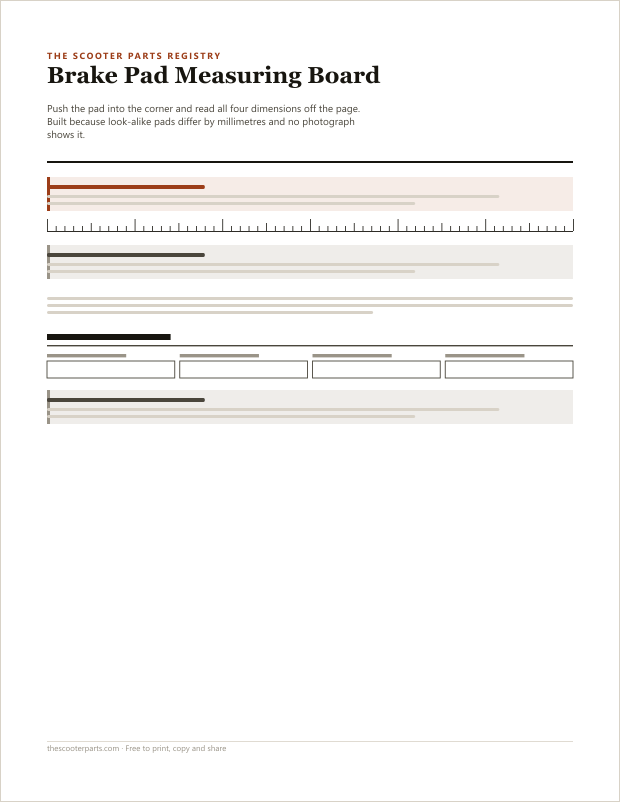
Layout preview of page one. The PDF itself is typeset text, not an image.
Download — free, no email
3 pages. No account, no sign-up, no newsletter. Print it, copy it, hand it to somebody else.
TSP-ME-13 · version v1.0 · September 2026. Opens in your browser's PDF viewer, where you can print directly.
The problem it solves
There is no reliable catalogue matching Chinese scooter models to brake pads, so pads are sold by shape and matched by eye from a photograph. Sellers themselves warn against it: one vendor's own listing tells buyers to look at both versions and measure closely, because the difference between two pads that look identical is a few millimetres of height and a bend in the backing plate.
This is the sheet that best explains why the whole library exists. An answer engine can tell you what a brake pad is. It cannot let you push one into a printed corner and read its height and width off two scales at once.
The obvious version of this sheet would be a library of printed pad silhouettes at true size, so you lay yours down and find the match. We are not publishing that, and the reason matters: we cannot source the outlines of the pads actually in circulation. A printed shape would be matched against and believed, and if it were a few millimetres out it would send somebody to buy the wrong pad with more confidence than they had before.
So what is printed is an instrument rather than a claim. Two true-size scales meeting at a corner, a 5mm grid, and a record block for the four dimensions and the backing-plate features that a seller can actually work from.
The mistakes this sheet exists to prevent
- Matching a pad against a listing photograph. The discriminating differences are millimetres of height and a bend that a photograph flattens.
- Measuring across the friction material rather than the steel backing plate. The material is worn; the plate is not.
- Measuring friction thickness in the middle, where it is thickest, instead of at its thinnest point.
- Recording the hole positions but not the plate's bend, which is one of the three things the vendor names as discriminating.
- Printing this sheet at "fit to page", which shrinks every dimension by about six per cent and makes the whole thing worse than useless.
Who it is for
- Anyone replacing pads on a machine no catalogue covers
- Owners choosing between several near-identical listings
- Anyone who has already been sent a pad that was two millimetres too tall
What is on it
- A true-size measuring board with scales on two edges and a 5mm grid
- The four dimensions sellers actually work from
- The three discriminating features a vendor names: overall height, height in the middle, and the plate's bend
- A backing plate feature checklist and a tracing area
How to use it
- 01Check the calibration rule with a steel rule before anything else. This sheet is worthless printed at the wrong scale.
- 02Clean the pad's steel backing plate so the edges are crisp.
- 03Push the plate into the marked corner and read the height and width off the two scales.
- 04Measure the height in the middle as well as overall — that is the dimension that catches people out.
Also in a pack
Use it with the registry
Other sheets you may want
- Scooter brake pad measurement and tracing cardChinese scooter pads are sold by shape, not by model. Trace yours, measure four dimensions, and compare against the listing photograph before you buy.
- Brake shoe arc template — which drum size do you have?True-size arcs at the two drum diameters the owner community reports. Lay the shoe on the page and see which one it belongs to.
- Scooter brake service recordWhat was fitted, what it measured when it came off, and how long it lasted. For the system where guessing is least acceptable.
Free to print, copy, and share — including in forums, clubs and workshops. If you find a mistake on this sheet, tell us and it gets corrected. Quote TSP-ME-13 and the version so we know exactly which sheet you mean. All printables.