Free printableMeasure partsTSP-ME-20
How to measure a scooter clutch and clutch bell
The half of the CVT that gets blamed on the belt. Four measurements and a wear inspection, with true-size circles for the bell.
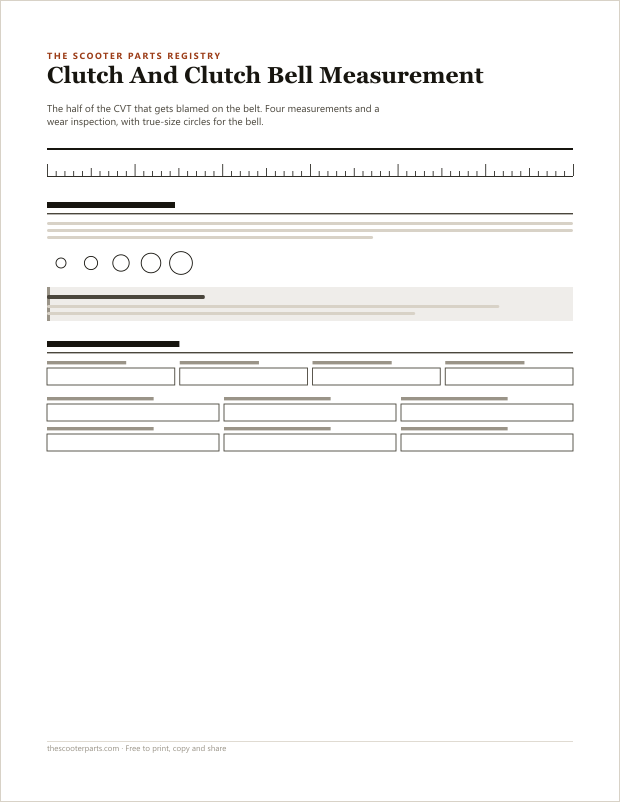
Layout preview of page one. The PDF itself is typeset text, not an image.
Download — free, no email
3 pages. No account, no sign-up, no newsletter. Print it, copy it, hand it to somebody else.
TSP-ME-20 · version v1.0 · September 2026. Opens in your browser's PDF viewer, where you can print directly.
The problem it solves
When a transmission slips or judders, the belt gets replaced. About half the time the belt was not the problem — the clutch shoes were glazed, the bell was worn oval, or the springs had elongated their own mounting holes. Then a new belt slips too, and the belt gets blamed again.
The clutch is the part of a scooter transmission that nobody thinks about, because it is hidden behind the bell and has no obvious service interval. It is also the part that makes the machine judder pulling away, flare its revs without moving, and glaze belts.
Bell inside diameter is the measurement that matters most and the one people cannot take, because getting a rule inside a bell squarely is awkward. Standing it on a printed circle solves that, and that is what the true-size circles on this sheet are for.
The other three measurements are straightforward once you know to take them, and the wear inspection catches the faults that no measurement shows — glazing, elongated spring holes and heat discolouration.
The mistakes this sheet exists to prevent
- Replacing a belt for a symptom the clutch was causing, then replacing it again.
- Cleaning glazed shoes and refitting them without also cleaning out the dust that caused the glaze.
- Using an oily cleaner on the friction faces, which makes the slip worse than before.
- Missing elongated spring holes in the shoes, which change engagement and are obvious once you look.
- Fitting new shoes into a bell that is worn oval or scored, which glazes them quickly.
Who it is for
- Anyone whose scooter judders or flares its revs pulling away
- Owners who have replaced a belt and still have the symptom
- Anyone opening the transmission and wanting to check everything while it is apart
What is on it
- True-size circles for bell inside diameter
- The four measurements, and where exactly to take them
- A wear inspection covering what measurement cannot show
- A record block that feeds the CVT service log
How to use it
- 01Check the calibration rule before using the circles.
- 02Stand the bell mouth-down on the circles to read its inside diameter.
- 03Measure friction material at its thinnest point, not its thickest.
- 04Look at the spring holes. Round is good; oval is a finding.
Use it with the registry
Other sheets you may want
- GY6 CVT slipping, juddering and squealingThree different noises from the same case, and they mean different things. What to look at with the cover off, in order.
- CVT service record for a GY6 or Chinese scooterThe transmission is the highest-wear system on a scooter and the least documented. One sheet for everything that goes in it, with the measurements taken each time.
- GY6 belt size chart and measuring sheetHow to read the three numbers printed on a scooter drive belt, how to measure a belt that has no readable markings left, and a record sheet for the one you have.
Free to print, copy, and share — including in forums, clubs and workshops. If you find a mistake on this sheet, tell us and it gets corrected. Quote TSP-ME-20 and the version so we know exactly which sheet you mean. All printables.